

Join the Dysregulation Insider get free calm parenting tips straight to your inbox!
YES, I'M IN!The Real Reason Transitions Are So Hard For Your Child | Emotional Dysregulation in Children | E347





Estimated Reading Time: 6 Minutes
Many parents feel exhausted by the daily battles that seem to happen around every transition. Mornings become stressful, after-school routines turn into meltdowns, and bedtime feels like a nightly struggle. The good news is that once you understand what's happening in the brain, everything starts to make more sense.
In this episode, I explain why transitions are so challenging for many children, what hidden factors make them harder, and how Regulation First Parenting® can help create calmer, smoother days.
Why does my child melt down during transition time?
Many parents are surprised by how intensely children react when asked to stop one activity and start another.
The problem usually isn't the transition itself.
The problem is what the transition requires from the brain.
Transitions demand:
- Flexibility
- Emotional regulation
- Attention shifting
- Executive functioning
- Stress tolerance
For a dysregulated child, those skills can feel incredibly demanding.
When stress levels rise, the brain's CEO—the prefrontal cortex—becomes less accessible.
This makes it harder for children to:
- Shift attention
- Follow directions
- Manage frustration
- Adapt to change
Common Factors That Make Transitions Harder
- ADHD
- Anxiety
- Sensory sensitivities
- Sleep deprivation
- Hunger
- Overstimulation
- Emotional overwhelm
Behavior is communication.
When your child melts down during transition time, they're often communicating:
"This feels too hard right now."
Real-Life Example
A child happily plays on a tablet for an hour but immediately erupts when asked to stop and start homework.
The issue isn't laziness.
The issue is the brain struggling to switch gears.
What hidden triggers make transitions more difficult?
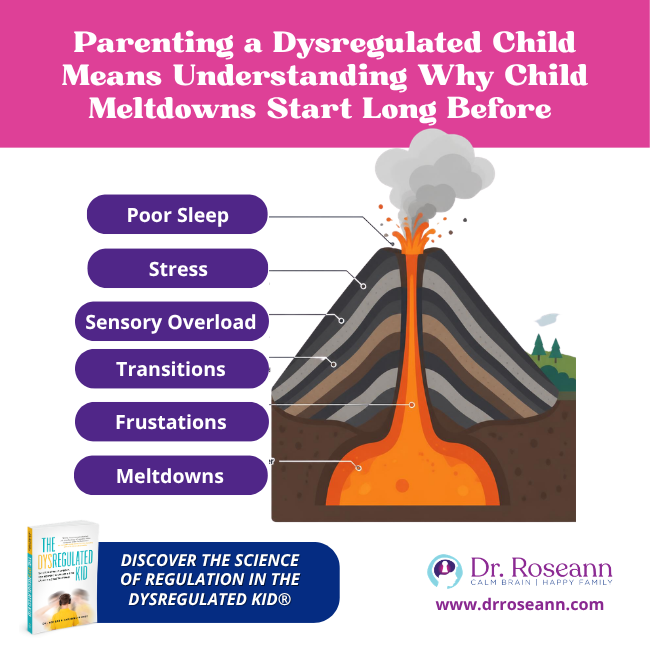
Many transition challenges begin long before the actual transition.
Parents often focus on the behavior they can see without recognizing the hidden stressors underneath.
Common Transition Triggers
Unpredictable Routines
Children thrive on predictability.
Unexpected changes often increase anxiety and nervous system activation.
Feeling Rushed
Even small changes in timing can feel overwhelming for a child who struggles with regulation.
Screen Transitions
Screens create intense engagement and dopamine activation.
Coming off a device often requires additional regulation support.
Emotional Stress
Family conflict, school pressures, friendship struggles, and anxiety can all make transitions harder.
Real-Life Example
One mother described school mornings as a daily war zone.
Her son cried, refused to get dressed, and frequently melted down before leaving the house.
After implementing a more predictable routine and adding regulation breaks before transitions, mornings became significantly smoother.
The issue wasn't behavior.
It was nervous system overload.
Think of yourself as a dysregulation detective.
Instead of asking: "Why won't my child listen?"
Ask: "What's making this transition feel so hard?"
How can I make transitions easier for my child?
The key to easier transitions isn't more discipline.
It's more regulation.
When children feel safe and supported, they become more capable of handling change.
Practical Transition Strategies
Preview and Prepare
Give advance notice whenever possible.
Try:
- Visual timers
- Five-minute warnings
- Countdown reminders
- Visual schedules
Predictability reduces stress.
Co-Regulate First
Before expecting cooperation:
- Sit together
- Take a few breaths
- Offer water
- Use calming connection
Your calm helps regulate your child's nervous system.
Build In Micro-Resets
Small nervous system resets can make a huge difference.
Examples include:
- Stretching
- Movement breaks
- Deep breathing
- Jumping jacks
- A quick snack
Offer Limited Choices
Children often cooperate more when they feel some sense of control.
Examples:
- "Do you want to walk or skip to the car?"
- "Would you like to brush teeth before or after pajamas?"
Limited choices reduce power struggles.
Practice During Calm Moments
Transitions are skills.
Skills improve through repetition.
The more children rehearse routines when calm, the easier those routines become during stressful moments.
Why are screen transitions so difficult?
One of the most common transition battles today involves technology.
Parents often say: "Everything is fine until I turn off the tablet."
That's because screens activate reward pathways in the brain.
When screen time suddenly ends:
- Dopamine levels shift
- Frustration increases
- Emotional regulation decreases
- Flexibility becomes harder
What Helps?
- Give transition warnings
- Use visual timers
- Schedule movement immediately afterward
- Offer a regulation activity before the next task
Real-Life Example
A child who routinely melted down after gaming began transitioning more smoothly when parents added a ten-minute outdoor movement break before homework.
The movement helped regulate the nervous system and ease the shift.
🗣️ "If transitions feel like daily battles, know this: the reason transitions feel overwhelming isn't because your child doesn't care. It's because their nervous system is overloaded." — Dr. Roseann
If you're tired of walking on eggshells or feeling like nothing works, get the FREE Regulation Rescue Kit and finally learn what to say and do during the hardest parenting moments. Become a Dysregulation Insider VIP today: www.drroseann.com/newsletter
Why do transitions feel so overwhelming for families?
When every transition becomes a battle, parents often start feeling defeated.
You may find yourself thinking:
- "Why is everything a struggle?"
- "Why can't my child just cooperate?"
- "What am I doing wrong?"
The answer is often simple:
You're not doing anything wrong.
Your child's nervous system is overloaded.
Every transition becomes an opportunity to teach regulation.
Every moment of connection helps build resilience.
Every calm response strengthens your child's ability to manage change.
Takeaway & What’s Next
Transitions aren't about willpower.
They're about regulation.
When we stop viewing transition struggles as defiance and start understanding them as nervous system challenges, everything changes.
Your child isn't giving you a hard time.
They're having a hard time.
Behavior is communication.
The more you focus on regulation before expectation, the easier transitions become.
Remember:
- Predictability helps.
- Connection helps.
- Co-regulation helps.
- Calm the brain first.
Small changes create big results.
It's gonna be OK.
Transitions and unexpected changes demand flexibility from the brain—something that gets much harder when a child is dysregulated. The Dysregulated Kid® helps you understand why these moments trigger big reactions and gives you practical tools to make change feel safer and more manageable. Get The Dysregulated Kid® at dysregulatedkid.com.
FAQs
Why does my child fight me every morning before school?
Morning routines involve multiple transitions happening quickly. For a dysregulated child, that can feel overwhelming. Predictable routines, preparation, and nervous system support can reduce morning stress.
How do I stop tablet or computer battles?
Give advance warnings, use visual timers, and build in movement or regulation activities after screen time. Sudden transitions from screens are especially difficult for many children.
Why does my child struggle more than their sibling?
Every nervous system is different. Some children require more support with flexibility, sensory processing, emotional regulation, and transitions than others.
Can practice really make transitions easier?
Yes. Repetition helps build neural pathways. Practicing routines during calm moments makes transitions feel more predictable and manageable over time.
Are transition struggles common in ADHD and anxiety?
Absolutely. Children with ADHD, anxiety, sensory sensitivities, and emotional dysregulation often have a harder time shifting attention and adapting to change.
Tired of not knowing what's really going on with your child?
The Solution Matcher gives you personalized recommendations based on your child's behaviors, challenges, and nervous system needs.
Get started here:
Dr. Roseann Capanna-Hodge is a licensed therapist, certified school psychologist, and leading expert in emotional dysregulation in children. With over 30 years of experience, she helps parents understand the root causes of meltdowns, anxiety, ADHD, and challenging behavior through the lens of nervous system regulation. Dr. Roseann teaches practical, science-backed strategies for co-regulation and how to calm a dysregulated child using her Regulation First Parenting® approach. She is the host of the Dysregulated Kids Podcast and author of The Dysregulated Kid.
Dr. Roseann Capanna-Hodge
Emotional Dysregulation in Children & Nervous System Expert
Regulation First Parenting® | CALMS Protocol™
Host of the Dysregulated Kids Podcast (Top 1% Globally)
Author of The Dysregulated Kid

Find this helpful? Leave us a review!
Your feedback helps more overwhelmed parents find calm, clarity, and the proven tools that make everyday life easier.
Dr. Roseann Capanna-Hodge: Helping Families of Dysregulated Kids Thrive Through Regulation First Parenting®
As the creator of Regulation First Parenting®, she’s helping families of dysregulated kids discover a compassionate, brain-based path forward. Through The Dysregulated Kids™ Podcast (top 2% globally), she offers practical strategies that help parents understand their child’s brain and support lasting change.
Through The Global Institute of Children’s Mental Health and Dr. Roseann, LLC, she’s created resources like the Neurotastic® Brain Formulas and the Regulation First Parenting® framework—meeting families where they are and supporting them through challenges like ADHD, anxiety, OCD, PANS/PANDAS, and behavioral struggles.
Recognized by Forbes as “a thought leader in children’s mental health,” Dr. Roseann is changing how we understand emotional dysregulation in children—one family at a time.